Shaoyan Liu
Battery safety, thermal runaway, and data-driven modeling

- Papers:
- 7
- Citations:
- 182
- h-index:
- 6
Greetings! I am Shaoyan Liu (劉 少言), a Ph.D. candidate in Energy Mechanics and Sustainability Laboratory (EMSLab) and Department of Mechanical Engineering at Penn State University, advised by Prof. Jun Xu. Previously, I completed my M.S. at Shanghai Jiao Tong University and my B.S. at Beijing Jiaotong University. My current research interests mainly lie in battery safety.
In my spare time, I enjoy doing sports (mostly running, cycling and working out at the gym), traveling, and going on hikes with friends (find my workout records on my Strava page
 ). Also, I enjoy music, photography, and philosophy.
News
-
[Oct. 2026] Passed the qualifier at Penn State!
-
[Sep. 2026] Started serving as a reviewer for the Journal of Power Sources. Honored to serve our community!
-
[Aug. 2026] Joined the Energy Mechanics and Sustainability Laboratory (EMSLab) at Penn State!
-
[Jul. 2026] Our review paper about gas-bridged aging and TR is accepted by Renewable and Sustainable Energy Reviews.
-
[May 2026] Completed all Ph.D. coursework with a GPA 3.8. Excited to start summer research!
-
[Oct. 2025] Joined the Electrochemical Engine Center (ECEC) at Penn State!
Selected Publications
-
 RSER
Renewable and Sustainable Energy Reviews, 241, 117225, 2026.
RSER
Renewable and Sustainable Energy Reviews, 241, 117225, 2026.Abstract
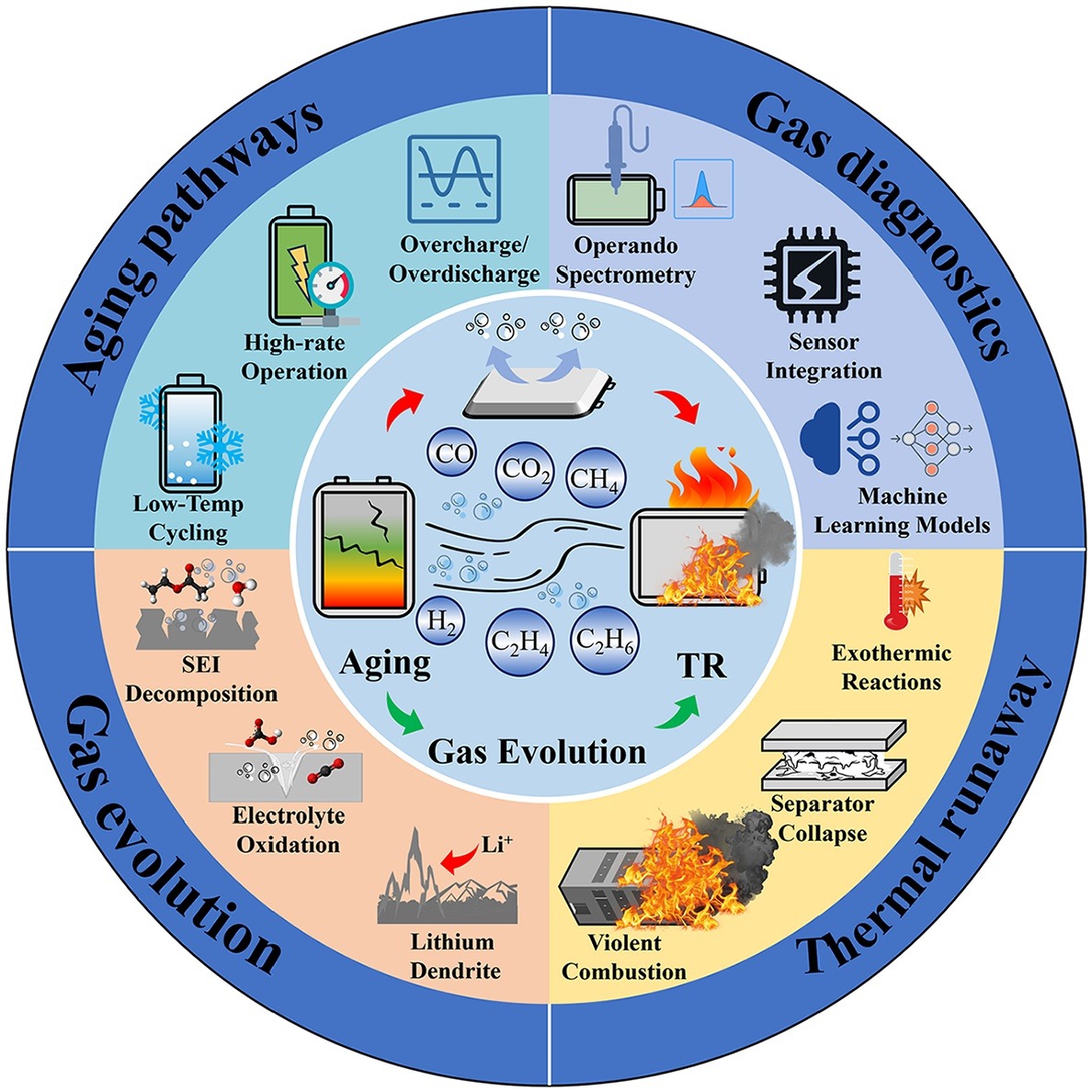
Lithium-ion batteries (LIBs) are increasingly used in electric vehicles and large-scale energy storage systems. However, their long-term operational safety remains a critical bottleneck, especially as batteries experience progressive aging during extended service. This review examines how primary aging pathways, including high temperature, low temperature, high C-rate cycling, and overcharge/over-discharge conditions, affect aging reactions and consequently influence thermal runaway (TR) behavior. Specifically, these aging pathways trigger different side reactions and produce characteristic gas signals, such as hydrogen, carbon oxides, and hydrocarbons. These gas signals can reflect the internal aging state of batteries and help explain changes in TR characteristics and overall thermal safety behavior. As the relationship among aging pathways and TR characteristics is strongly path-dependent, gas evolution is reviewed here as a bridge linking aging mechanisms with thermal safety assessment. Moreover, the review further examines how gas signals can be integrated with machine learning methods to support TR diagnosis and early warning. This combined perspective helps improve the safety design and operation of LIBs.
-
 JES
Journal of Energy Storage, 125, 116855, 2025.
JES
Journal of Energy Storage, 125, 116855, 2025.Abstract
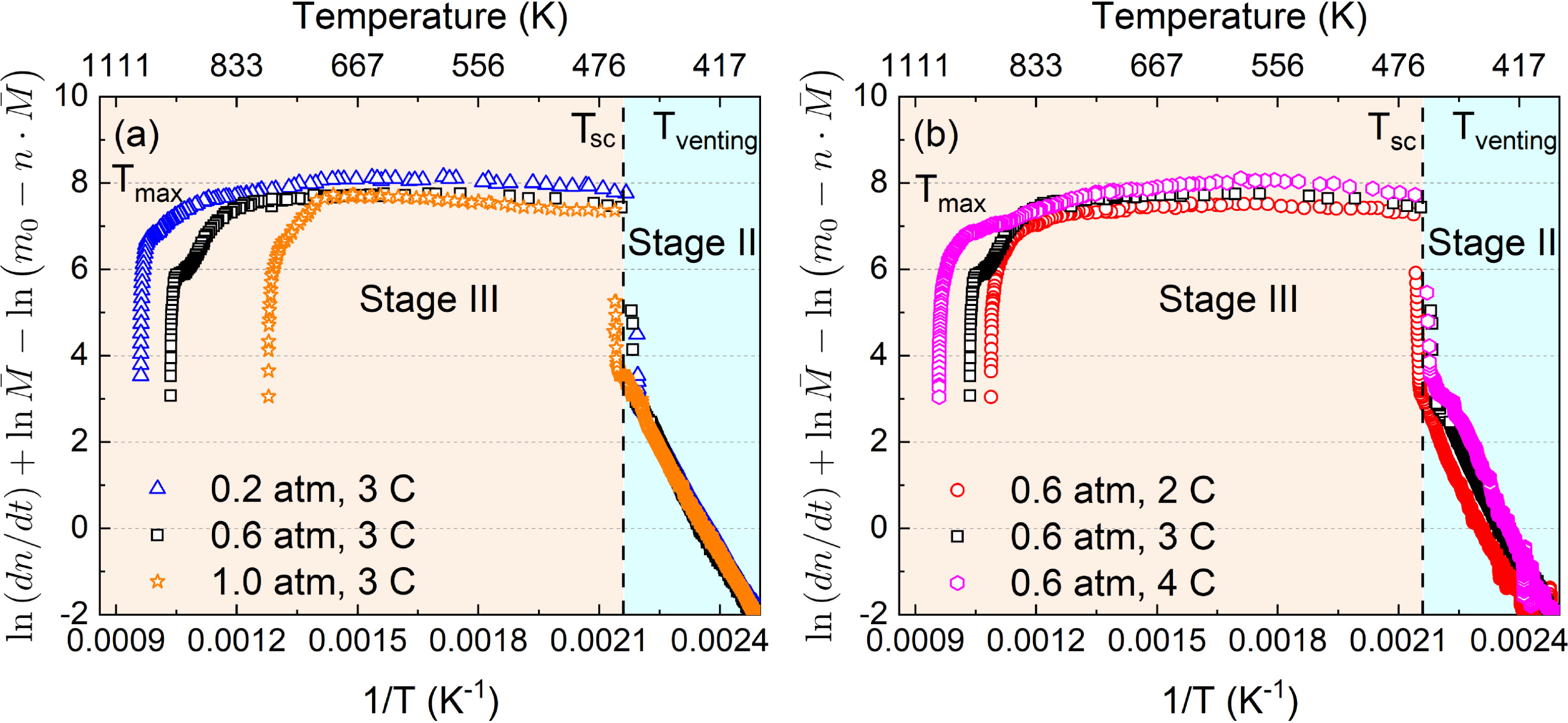
With the increased demand of lithium-ion batteries in aviation and high-altitude applications, understanding battery safety at low-pressure conditions becomes paramount. This study aims to comprehensively investigate the effects of ambient pressure and charging rate on the thermal runaway behaviors and corresponding gas generation dynamics of commercial 18650-type LiNi₁/₃Co₁/₃Mn₁/₃O₂ (NCM) cells triggered by electrical abuse, employing an accelerating rate calorimeter. The results indicate that low ambient pressure leads to an earlier opening of the safety valve and a shortened delay time of violent thermal runaway, which limits electrolyte ejection outside the cell. Due to the greater participation of electrolytes during thermal runaway, the maximum temperature and gas generation amount both increases at low ambient pressure conditions. Besides, it is found that an elevated charging rate intensifies the thermal runaway process, increasing the potential for thermal runaway hazards, as indicated by the increased generation of flammable gases. Furthermore, the Arrhenius law is employed to evaluate the gas generation dynamics of LIBs during thermal runaway by comparing the activation energy and pre-exponential factors. Therefore, the rate constants for various operation pressures and charging rates are proposed. Significantly, the rate constants show a notable increase at low-pressure conditions, highlighting the higher TR risk in such conditions.
-
 CRPS
Cell Reports Physical Science, 6(5), 102563, 2025.
CRPS
Cell Reports Physical Science, 6(5), 102563, 2025.Abstract
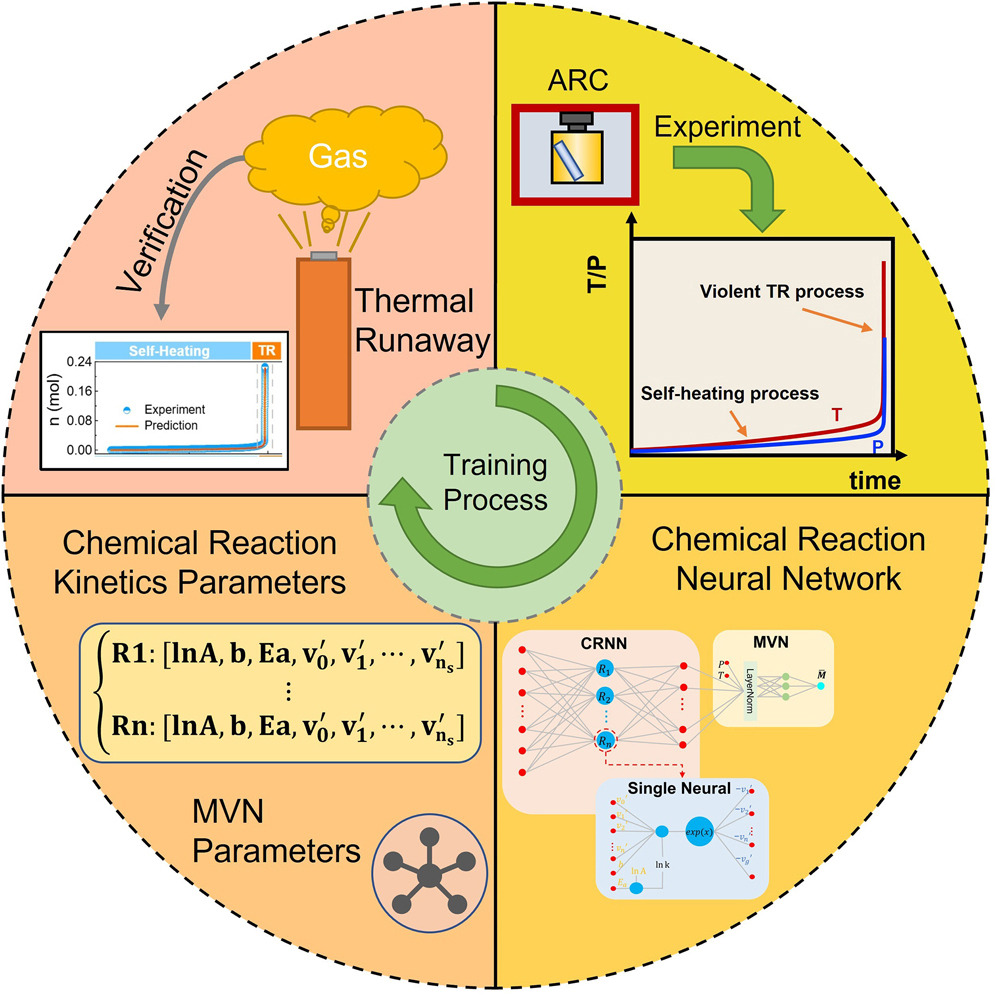
The widespread application of lithium-ion batteries in electric vehicles is hindered by safety concerns, notably thermal runaway. Understanding gas generation during thermal runaway is crucial for battery safety design, early fault detection, and fire hazard assessment, but existing kinetic models remain inadequate. We investigate gas generation behavior of 18650-type LiNi₁/₃Co₁/₃Mn₁/₃O₂ cells across varied states of charge, constructing a training dataset to develop a chemical reaction neural network model that autonomously explores unknown reaction pathways and corresponding chemical kinetic parameters. By incorporating an additional non-linear neural network to predict the mean molar weight of generated gases, the model trains a chemical kinetic mechanism comprising 7 species and 16 reactions. The resulting mechanism accurately predicts key parameters, including gas generation rates and amounts, during thermal runaway. This methodology addresses the current limitations in thermal runaway gas prediction, providing a robust framework for enhancing battery safety.
-
 IJHE
International Journal of Hydrogen Energy, 48(97), 38484-38495, 2023.
IJHE
International Journal of Hydrogen Energy, 48(97), 38484-38495, 2023.Abstract
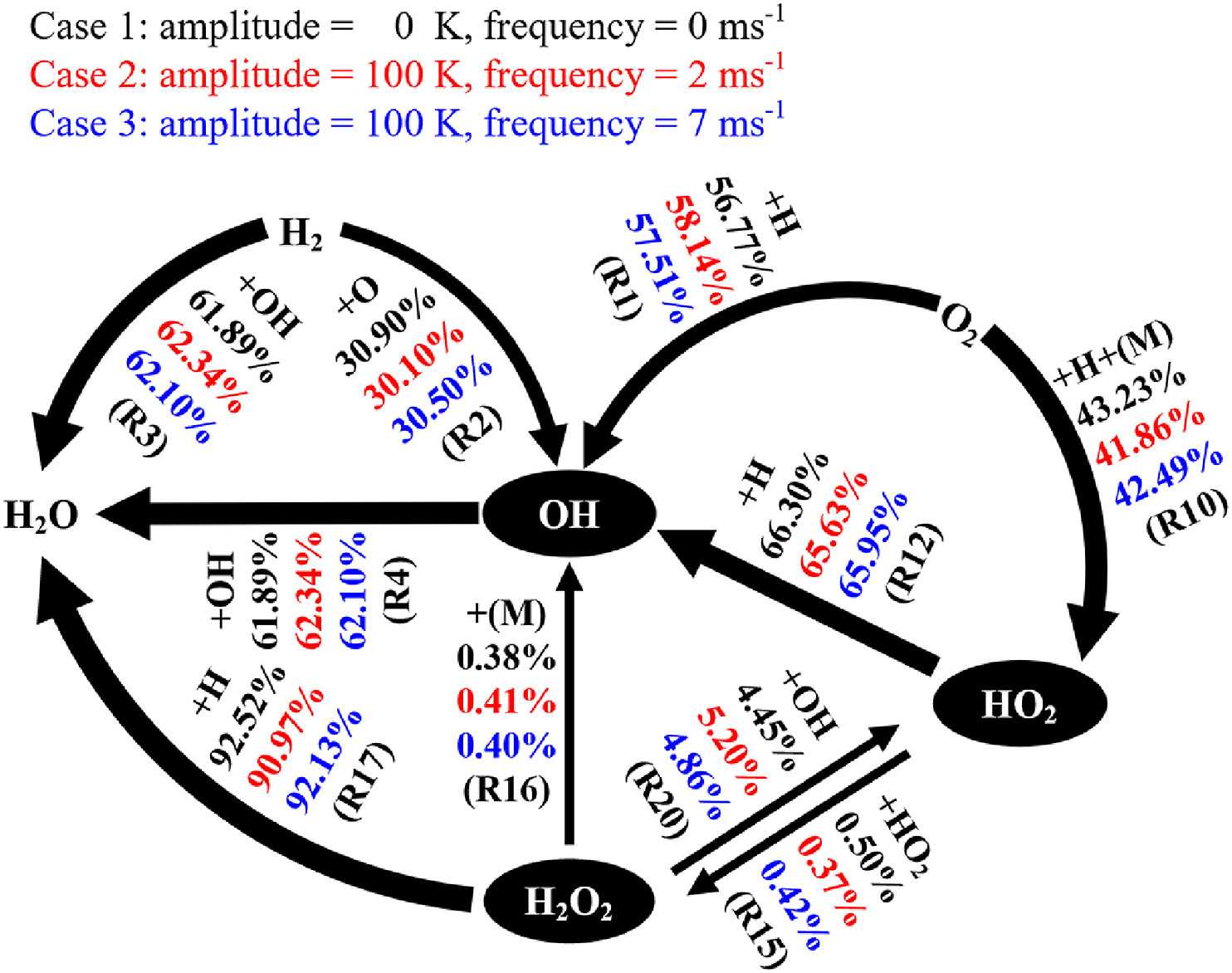
Intake temperature and pressure fluctuations prior to main ignition are one of the reasons affecting the efficiency of internal combustion engines. In this study, the effects of temperature and pressure fluctuations with varied amplitudes and frequencies on the exergy loss of hydrogen auto-ignition processes were numerically investigated in an adiabatic constant-volume system at engine-relevant conditions. The results revealed that the increase in temperature fluctuation amplitudes primarily decreases the exergy loss due to chemical reactions, and the exergy loss due to incomplete combustion remains unchanged. Specifically, the total exergy loss is reduced by approximately 1.5% with a temperature fluctuation amplitude of 100 K at a frequency of 2 ms⁻¹. Furthermore, with the same temperature fluctuation amplitude, increasing the frequency of temperature fluctuation from 2 ms⁻¹ to 7 ms⁻¹ leads to a 0.7% increase in the total exergy loss. On the other hand, the effects of pressure fluctuation on the exergy loss of hydrogen auto-ignition processes are negligible compared with those of temperature fluctuation. Through chemical kinetic analysis, it is found that temperature fluctuation promotes the consumption pathway of O₂ to generate OH, rather than the collision with H to produce HO₂. Consequently, the reduced mole fraction of HO₂ inhibits the related HO₂-consumption reactions, including HO₂+H=OH + OH and HO₂+HO₂=H₂O₂+O₂. Moreover, with temperature fluctuation, due to the lower fraction of third-body collision molecules, H₂O, the reactivity of the third-body reaction, H + O₂+M=HO₂+M, is decreased. The reduced reaction rates of these reactions lead to decreased total exergy loss, indicating that the fuel energy conversion process may benefit from temperature fluctuation.